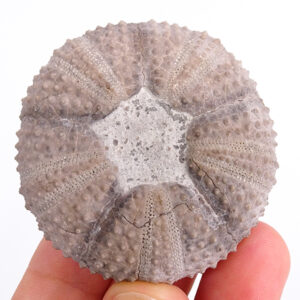

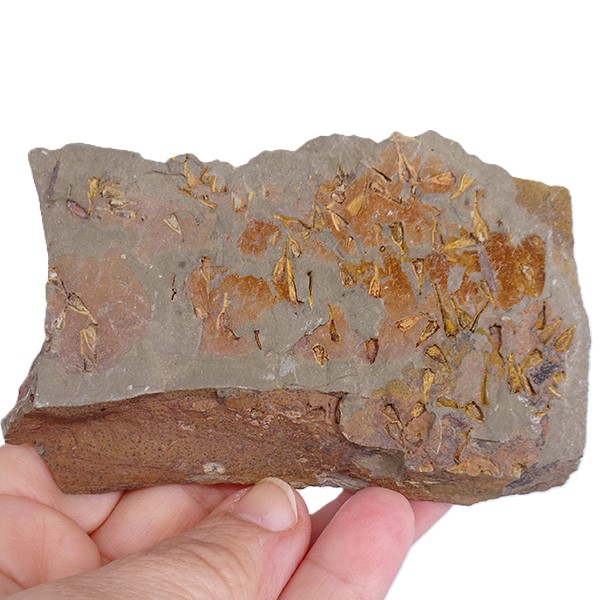
Rhopalocystis destombesi
35,00 €
System: Ordovician.
Stage: Tremadocian.
Formation: Fezouata.
Origin: Zagora, Morocco.
Plate measurements: 10.7 cm x 7.1 cm
Eocrinoid.
Eocrinoids are among the oldest groups of echinoderms, appearing in the Early Cambrian and becoming extinct in the Silurian. Eocrinoids were benthic and sessile marine animals. Like most echinoderms, their bodies were protected by a set of interlocking calcareous plates, forming a teak solid and elongated, often shaped like a sac or a rounded cone, containing the mouth in the center, surrounded by arm-like appendages called brachioles and the other end of the teak was a fixing organ that was attached to the substrate and that in some genus may be absent.
The Fezouata deposits, near the Moroccan city of Zagora, are providing a rich sample of a fauna similar, although later in time, to the famous Burgess Shale (Canada). We are talking about fossils between 480 and 472 million years old. The age indicates that the Burgess Shale type communities were not restricted, as was believed, to the early stages of the Cambrian and then suddenly disappeared, but rather they survived much longer, coexisted with the later fauna and would be the normal type of deep sea fauna throughout the planet. So Morocco was an ocean and was over the South Pole.