

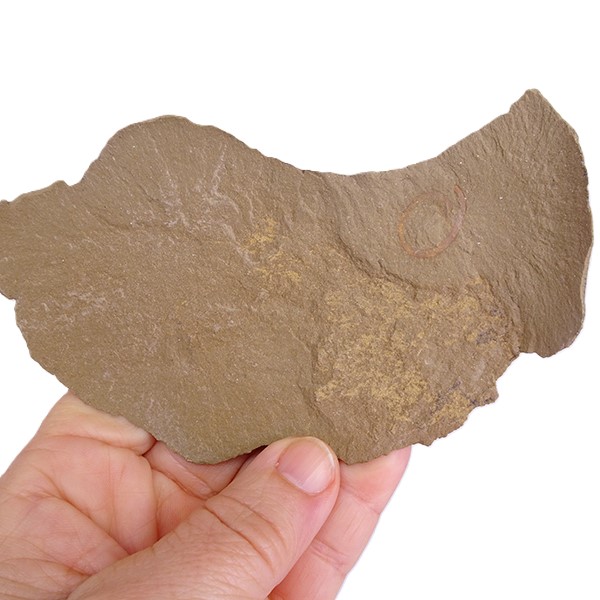
Palaeoscolex tenensis
180,00 €
System: Ordovician.
Stage: Tremadocian.
Formation: Fezouata.
Origin: Zagora, Morocco.
Plate measurements: 13.4 cm x 8 cm
Palaeoscolex belongs to the superphylum Palaeoscolecida. The paleoescolecids They have a cylindrical, elongated appearance (they can reach tens of centimeters in length) and narrow. The body is divided into two main parts: one proboscis armored and a trunk partially covered with a cuticle segmented.
The proboscis It is covered internally by numerous muscle fibers, allowing the movement of said structure. The cuticle It is composed of various interlocking phosphatic plates of multiple sizes and covers most of the body. These structures form a repeatable transverse pattern that imparts a segmented appearance to the entire trunk. The only differentiation of the trunk is in the front and back. The anterior is radially symmetrical, while the trunk is bilaterally symmetrical. The posterior part houses the terminal anus.
The Fezouata deposits, near the Moroccan city of Zagora, are providing a rich sample of a fauna similar, although later in time, to the famous Burgess Shale (Canada). We are talking about fossils between 480 and 472 million years old. The age indicates that the Burgess Shale type communities were not restricted, as was believed, to the early stages of the Cambrian and then suddenly disappeared, but rather they survived much longer, coexisted with the later fauna and would be the normal type of deep sea fauna throughout the planet. So Morocco was an ocean and was over the South Pole.