
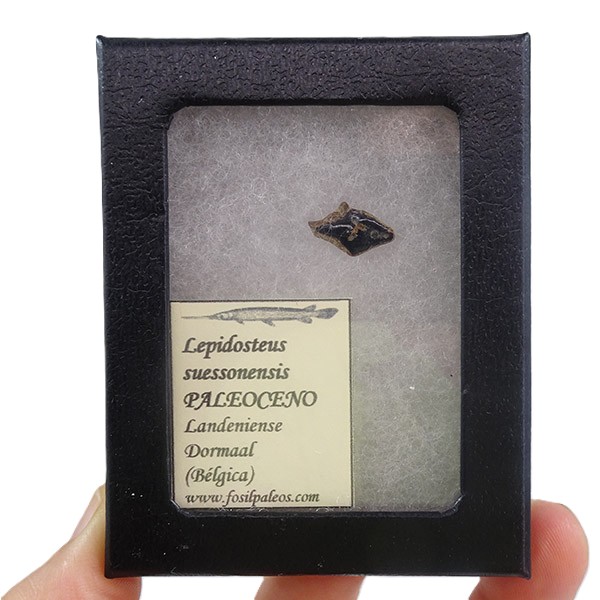
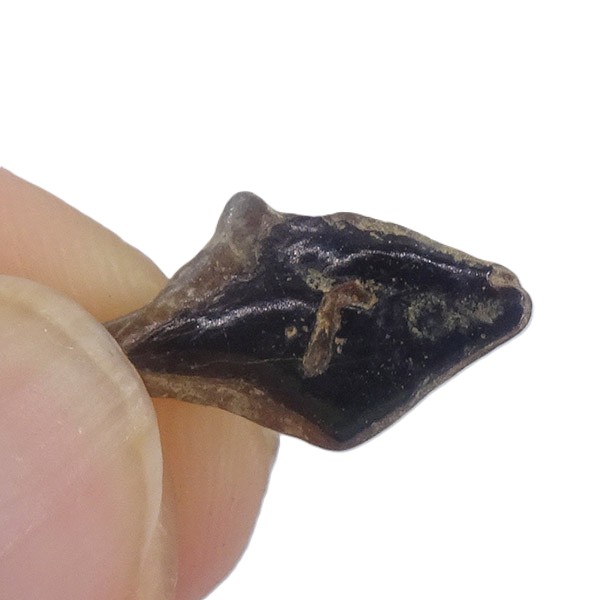
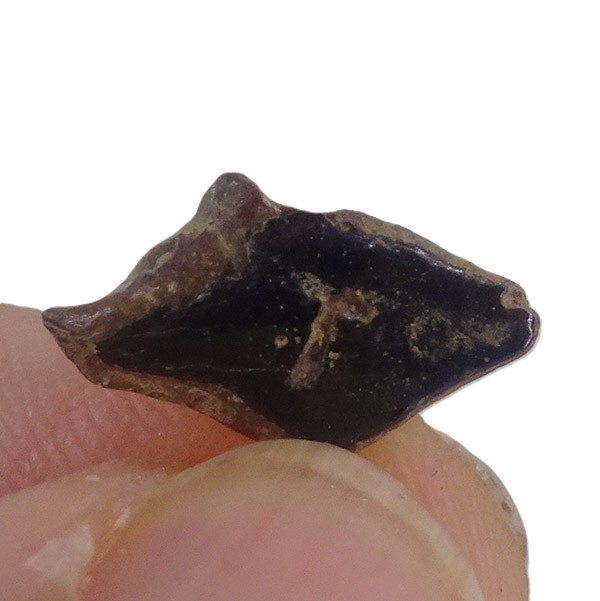
Lepidosteus suessonensis
4,00 €
Series: Paleocene.
Stage: Tanetian (Landenian).
Origin: Dormaal, Belgium.
Measurements: 1.4 cm x 0.9 cm
Ganoid scale of fish, from the collection of Fritz J. Kruger (December 28, 1941 in Stettin; † January 30, 2025 in Braunschweig).
Lepidosteus is a genus of fish belonging to the infraclass Holostei. The holosteans (Holostei, from the Greek ολόκληρο, "whole" and οστό, "bone") present:
- almost completely ossified skeleton.
- ganoid scales (layered, sandwich-like structure with a basal layer of lamellar bone, a layer of spongy bone with blood vessels, a layer of dentin, and an outer layer of enamel).
- persistent notochord. The notochord is a flexible rod-shaped embryonic structure present in all chordates, including humans, during at least one stage of their development. It acts as an axial support that helps organize the body of the embryo and, in vertebrates, is replaced by the vertebral column.
They are freshwater and estuarine fish that have inhabited the Earth since the Mesozoic era. They have an extensive fossil record dating back to the Cretaceous period. There are fossil records of Lepisosteidae in Europe, Asia and America, but only in the American continent are there living species. This suggests that in past times these fish had a much wider distribution compared to today.
In addition to the long and narrow snout, the genus is characterized by having rhombic, hard and shiny scales. This genus groups species of primitive bony fish. These fish are among the groups of oldest freshwater fish that exist today, becoming classified as "living fossils".
The box is included in the price.