
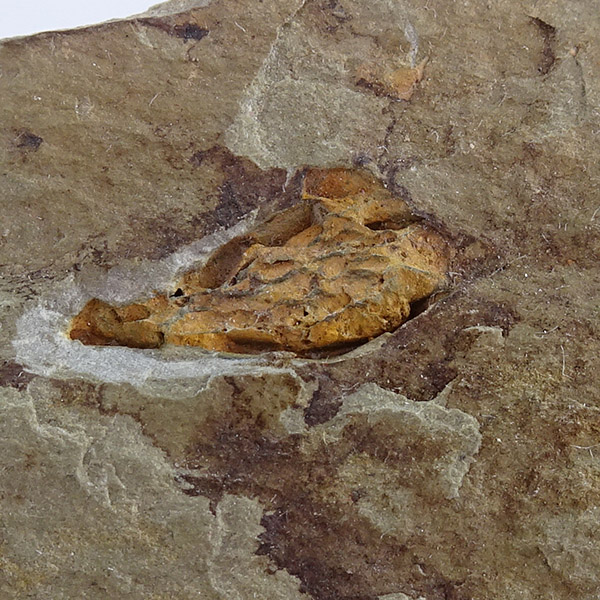
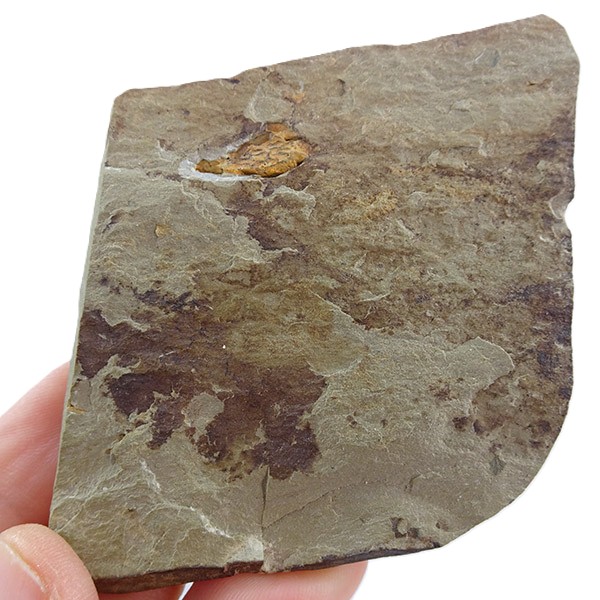
Sucocystis theronensis SOLD
System: Cambrian.
Origin: Black Mountain, Hérault, France.
Plate measurements: 6.5 cm x 6.2 cm
Sucocystis was a carpoid echinoderm of the class Cincta. Carpoids lived in the Paleozoic seas and their anatomy is strange and highly controversial. They are completely asymmetrical, some have a tail and the mouth, for example, occupies the right front part of the animal. All these characteristics are not present in current echinoderms. This strange anatomy is responsible for paleontologists arguing about which group of animals they belong to, without reaching an agreement.
These fossils provide important information about how these strange organisms lived. Researchers say that they lived resting on the seabed with their wake (tail), against the currents. The body was raised above the bottom by means of some bulges on the underside. These lumps were aligned, configuring two corridors that channeled the water currents that accelerated in speed when they passed under the animal. In this way the particles at the bottom were put into suspension and the animal captured them with its mouth, located against the currents, to feed itself. To prevent the currents from dragging the animal and potentially damaging it, it developed a strange asymmetrical shape with very wide axe-shaped plates that favored traction on the seabed. This strange anatomy is found in another group of primitive echinoderms, the stylophorous carpoids, and has been interpreted as a case of evolutionary convergence. Surely both groups developed similar structures because they lived in similar ecosystems.