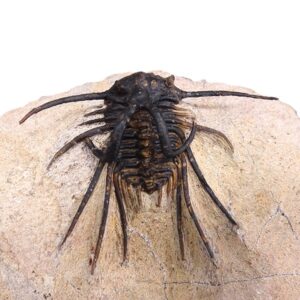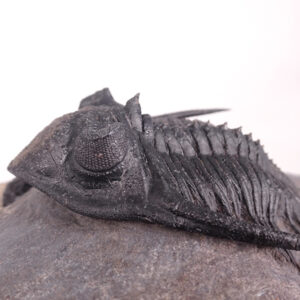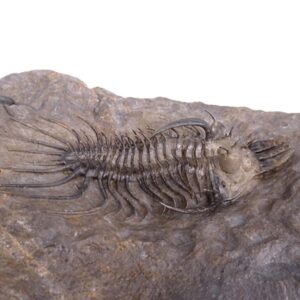

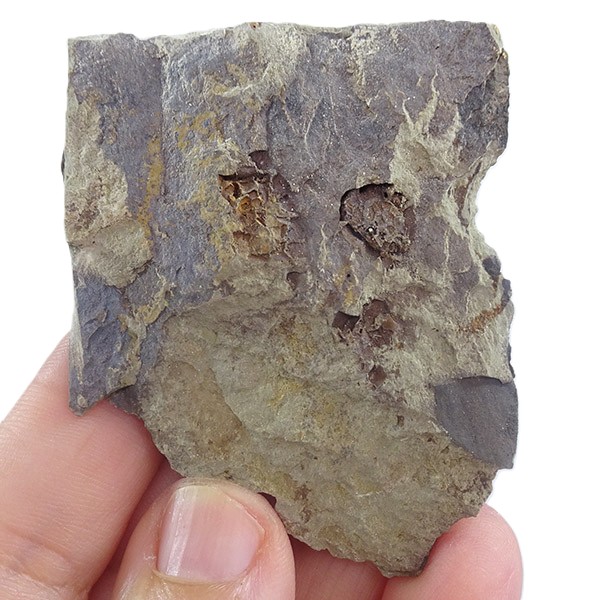
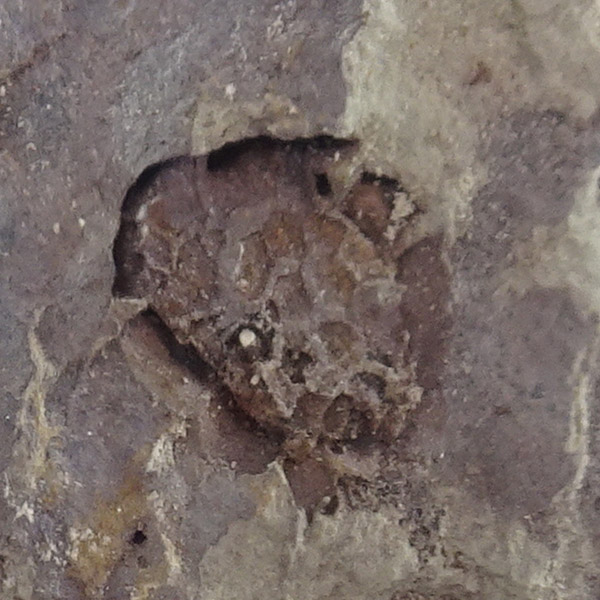
Elliptocinctus barrandei
48,00 €
Origin: Coulouma, Black Mountain, Hérault, Occitania region, France.
Elliptocinctus belongs to the order Cincta.
The homosteleans (Homostelea) are an extinct class of homolozoan echinoderms that include a single order, the cinctos (Cinta). They are a group of very primitive echinoderms. They are asymmetrical, with an apparently bilateral symmetry. They have a body made up of plates, divided into two sections:
1. teak or main body
Theak has a marginal ridge of large, elongated plates, or cinctus, surrounding a central area composed of smaller plates. In most representatives of the group, the body has a shape distantly reminiscent of a racket.
The teak has three openings:
- mouth, located on the right side of the anterior end, associated with the marginal grooves;
- anus, located near the anterior end of the right side, showing that the digestive system would be U-shaped;
- portal, the largest opening, which constitutes the main autopomorphy of the group, and is located at the anterior end. This portal is covered by an operculum and has been interpreted as a gill opening.
2. classroomcophore or flattened terminal appendage.
Cinctas were sessile organisms (attached to the substrate) and filtered food by pumping water through the gill slits of the pharynx.
This group lived during the Middle Cambrian.
https://echino.wordpress.com/tag/conoclypeus/