
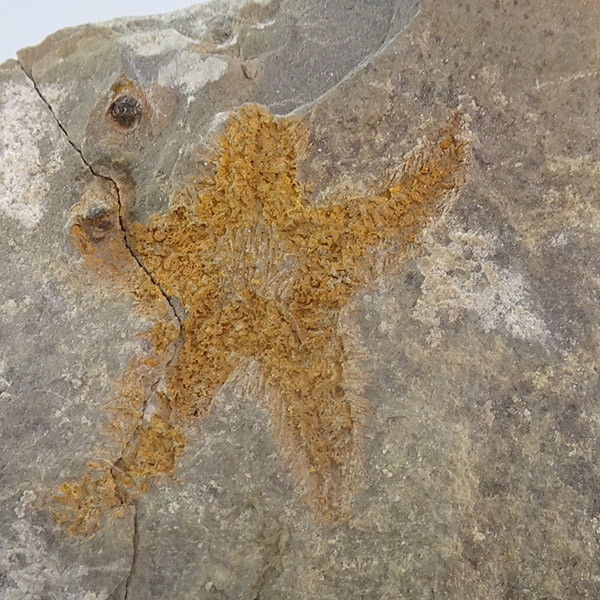
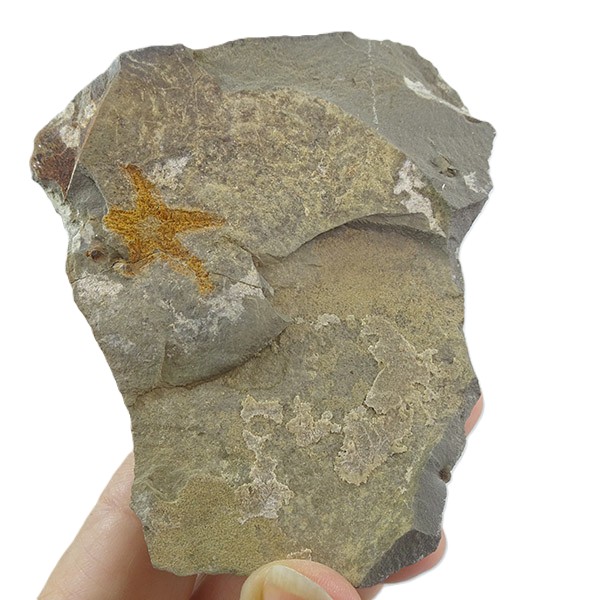
Cantabrigiaster fezouataensis SOLD
System: Ordovician.
Formation: Fezouata.
Origin: Zagora, Morocco.
Piece measurements: 9 cm x 8 cm
Cambridge researchers have discovered a fossil of the first starfish-like animal, which helps us understand the origins of these creatures.
The starfish prototype, which has characteristics in common with both sea lilies and modern starfish, is a missing link for scientists trying to reconstruct its early evolutionary history. The new species is unusual because it does not have many of the key characteristics of its contemporary relatives, lacking about 60% of the body plan of a modern starfish.
Cantabrigiaster fezouataensis Exceptionally preserved, with lace-like feathery arms, it has been frozen in time for approximately 480 million years.
The Fezouata deposits, near the Moroccan city of Zagora, are providing a rich sample of a fauna similar, although later in time, to the famous Burgess Shale (Canada). We are talking about fossils between 480 and 472 million years old. The age indicates that the Burgess Shale type communities were not restricted, as was believed, to the early stages of the Cambrian and then suddenly disappeared, but rather they survived much longer, coexisted with the later fauna and would be the normal type of deep sea fauna throughout the planet. So Morocco was an ocean and was over the South Pole.