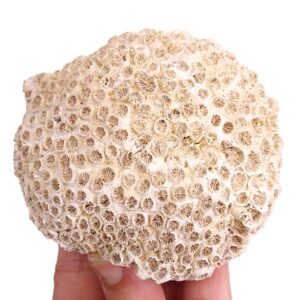

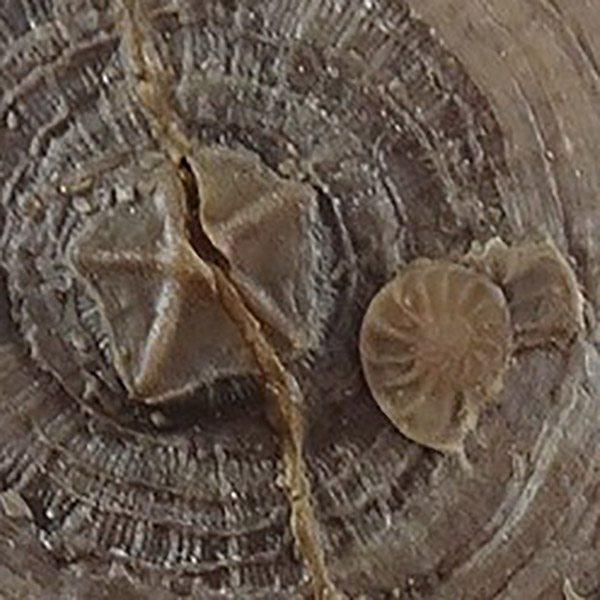
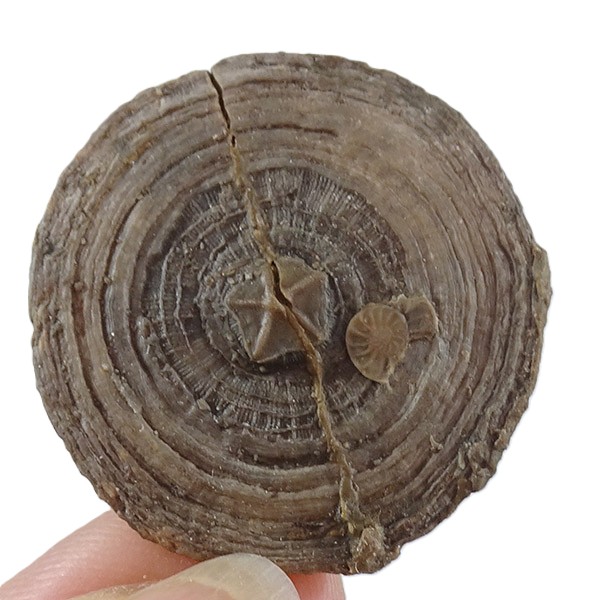
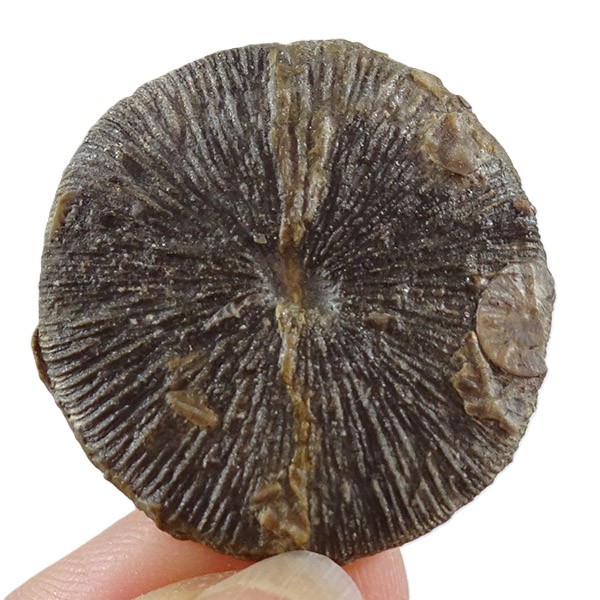
Cycloseris barcelonensis, Asterocyclina stellata stellata and Operculina sp. SOLD
Series: Eocene.
Origin: southern Europe.
Measurements: 3.1 cm x 3.1 cm
About Cycloseris (coral) are found Asterocycline and Operculin (macroforaminifera). Macroforaminifera reach centimeter sizes and therefore, having a relatively large, thick and heavy shell, for their size, they lived near the seabed as part of the benthos.
Foraminifera are unicellular and eukaryotic organisms (defined nucleus), provided with a shell mineralized by carbonates and in some cases by silica or other substances, which belong to the kingdom of protists. They appeared in the Cambrian (early Paleozoic) and persist today in countless marine environments.
Foraminifera are mainly carnivorous, they feed on other microorganisms that they trap with pseudopodia (expansions of their cytoplasm). These pseudopods pass through their shell through some perforations they have in it. They live on the seabed or on plants, moving slowly using pseudopodia. While others live fixed to different elements of the background.
Some of them live in symbiosis with photosynthetic organisms, so they are located near the surface or on the seabed where light can reach.
They are excellent guide fossils, since they serve to date rocks, determine marine environments (temperature, depth, salinity, paleolatitude, etc.) and know the prevailing climate in past times.
Foraminifera contribute to preventing climate change, since they fix enormous amounts of CO2 in their shells, in the form of calcium carbonate, preventing it from becoming part of the greenhouse gases in the atmosphere.
Foraminifera record the salinity and temperature of the waters quite accurately in their shells, making them excellent paleoclimatic indicators. The mass extinction of these organisms indicates major catastrophes, such as the fall of a large meteorite 65.5 million years ago.