
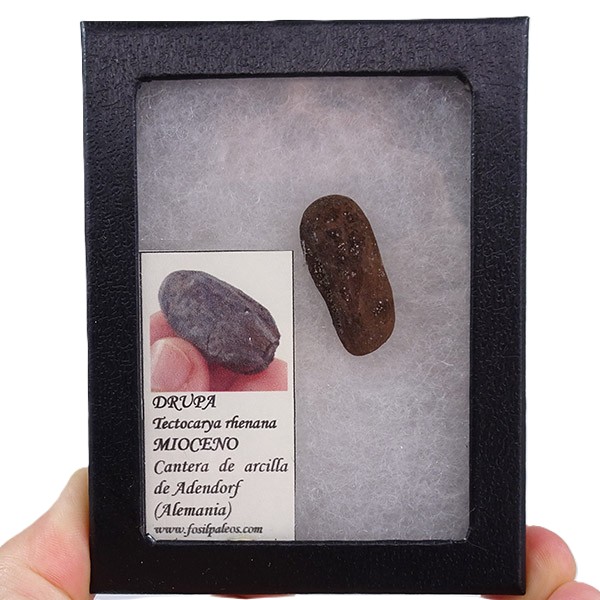
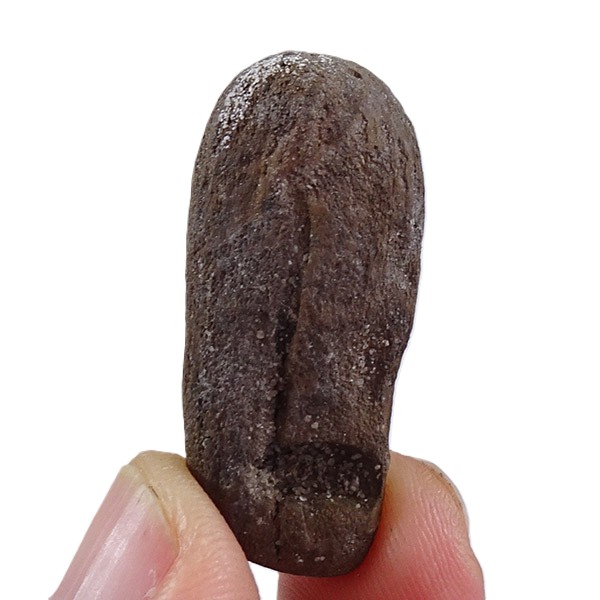
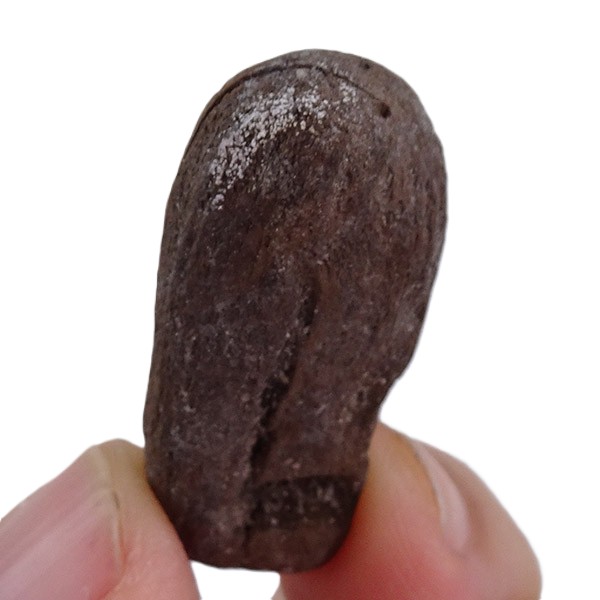
Tectocarya rhenana
25,00 €
Series: Miocene.
Provenance: Adendorf clay quarry, Germany.
Measurements: 3.2 cm x 1.4 cm
1 in stock
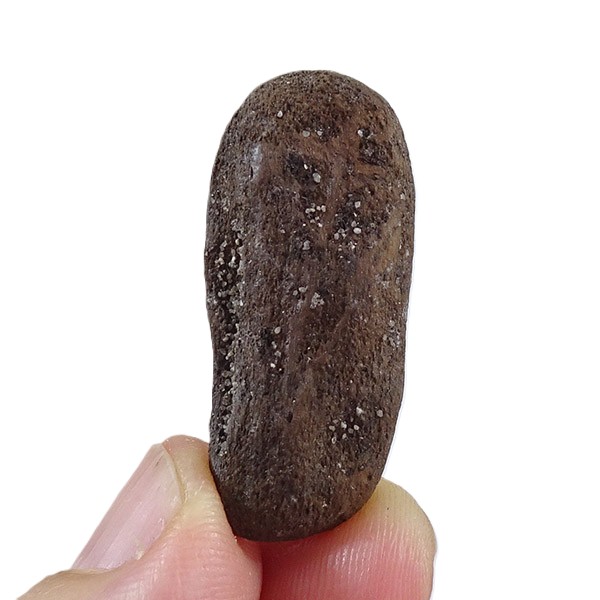
Drupe fruit of Tectocarya, From an old collection.
A drupe is a type of fleshy fruit with a seed enclosed in a hard stone, called an endocarp, which in turn is surrounded by a pulp (mesocarp) and a skin (epicarp). Common examples of drupes are cherries, peaches, plums, olives and mangoes.
Tectocarya It is a genus of plants belonging to the Mastixiaceae family that is characterized by resinous perennial trees with simple, alternate or opposite leaves, and drupaceous fruits.
Currently, the Adendorf Mine contains predominantly light gray silty sands to clays over weathered Devonian rocks, the Tertiary thickness is approximately 46 m. In the lower half of the outcrop, two lignite horizons are distinguished, which can be traced along the entire outcrop. Additionally, there are numerous channel systems with pronounced erosion unconformities, as well as stratified and lenticular concentrations of plant remains, including seeds, fruits, leaves, and conifer cones. These deposits are interpreted as wash lines in the area of meandering rivers. The rich macroflora of the Adendorf clay quarry was studied in particular by GOSSMANN (1989) and WINTERSCHEID (1990). The plants can be assigned to a species-rich mixed laurel forest, while on the sandbanks the pine and laurel forest elements formed much more species-poor stands.
Most of the finds come from accumulations interpreted as wash margins. Tree trunks up to several meters long are found here, as well as cones, fruits and seeds. Very common elements are Pinus sp. (Pinaceae = pine family), Trigonobalanopsis exacantha (Fagaceae = beech family), Tectocarya sp. y Mastixia sp. (both Mastixiaceae), Leucothoe narbonnensis (Ericaceae = heather family), Sphenotheca incurva y Symplocos sp. (both Symplocaceae). The flora of coarse clastic gullies, on the other hand, is much poorer in species and consists of larger remnants (cones of Pinus and Mastixiaceae). A flora poor in species was also recovered in the two lignite seams, where Carpolithus hafniensii is the most common (Carpolithus is a collective genus for systematically unclassifiable fruits or seeds). This species is frequently found in lignite seams or high-carbon sediments in the Rhineland and is considered typical of peat bog and swamp biotopes.
The box is included in the price.