
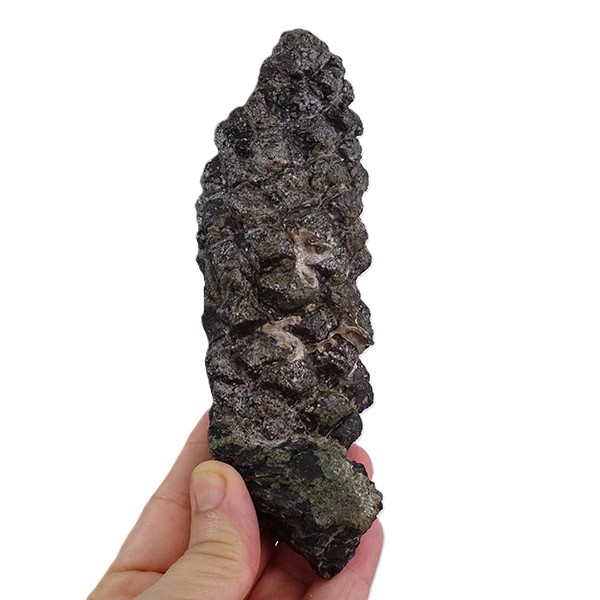
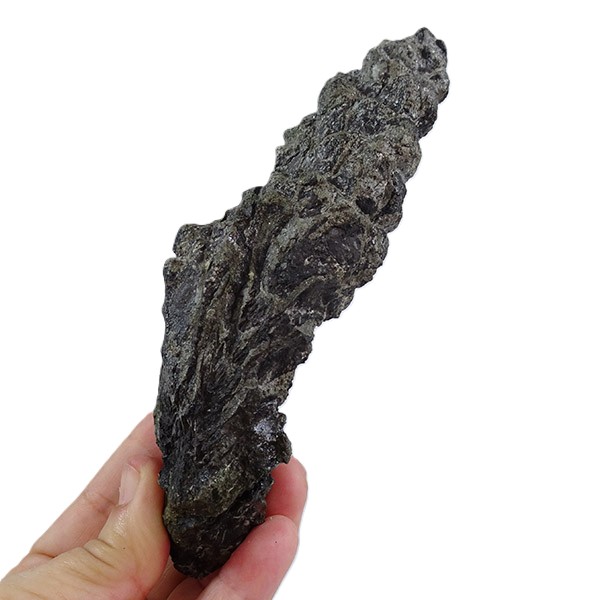
Pinus destefani SOLD
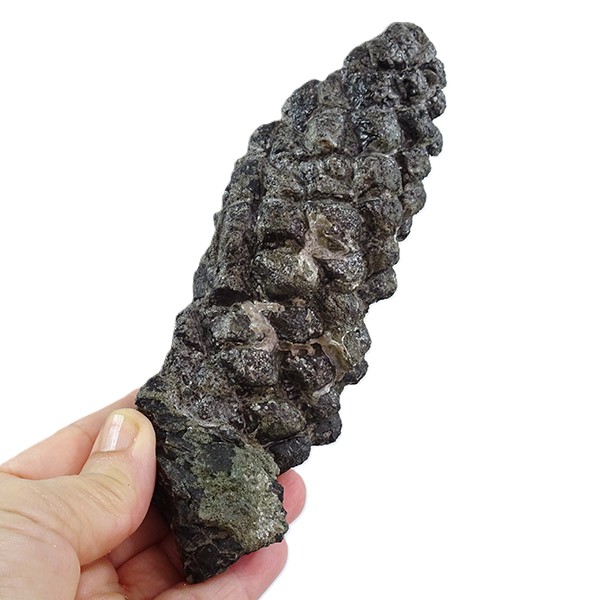
Series: Miocene.
Origin: Villa Sant'Antonio, province of Oristano, Sardinia, Italy.
Measurements: 16.8 cm x 6 cm x 4.7 cm
Inflorescence or female cone of Pinus destefani, From an old collection. They are extraordinarily well-preserved fossilized pine cones, originally discovered in the province of Oristano. The original site where these specimens were extracted was submerged under a lake and closed decades ago, which has turned the pine cones into Pinus destefani in pieces highly coveted by collectors.
A female cone is a structure formed by a central axis in which numerous scales are placed in a spiral with a generally helical arrangement, called tectric bracts, on each of which are one or several seminiferous bracts and on them appear the seminal primordia, which after pollination and subsequent fertilization, must be transformed into seeds. In pines and nearby genera, the seminiferous scale can detach along with the seed, acting as a wing that favors anemochorous dispersion (wind as the main transport agent).
Female cones are called cones in pines and other pinaceae (family Pinaceae), but they may have other names and appearances in different conifers; This is what they call galbules in junipers and junipers, and arcestids in cypresses, all members of the cupressaceae family (Cupressaceae)..
In short, conifers are gymnospermous (fruitless) plants that produce seeds in cone-shaped structures. As the ovules are not enclosed in an ovary, the seeds of the cones are not housed in a fruit, nor do they have a fleshy covering (aril) as is the case with conifers of the Taxaceae and Cephalotaxaceae families.