
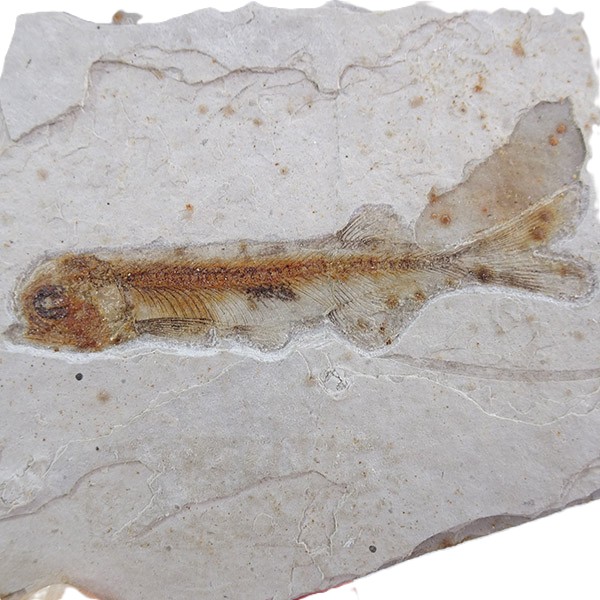
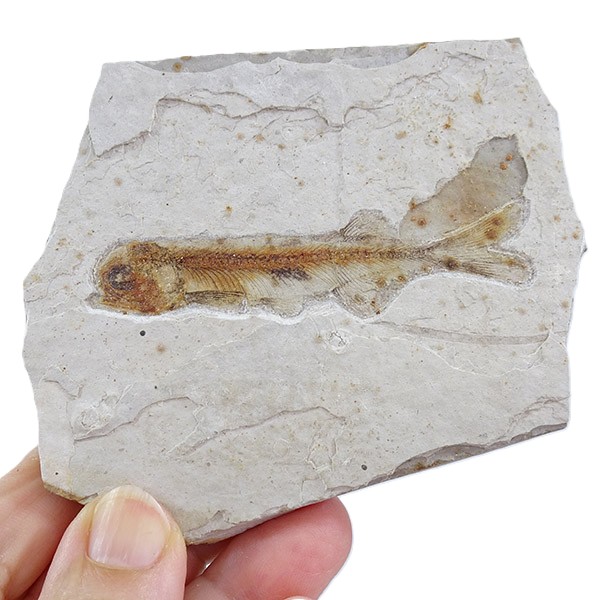
Lycoptera sp.
37,00 €
System: Lower Cretaceous.
Formation: Lower Yixian.
Origin: Beipiao, Liaoning Province, China.
Measurements: 9.3 cm x 8 cm
Lycoptera is an extinct genus of small freshwater fish that was covered with small oval scales and many of these specimens preserve small details and soft tissue impressions. The fossils of Lycoptera They are commonly found in large groups, which were quickly buried together in fine lake sediments. This probably indicates that in life they were very gregarious, agglomerating in schools of fish.
They lived from the late Jurassic to the Cretaceous in what is now China, Korea, Mongolia and Siberia. They constitute an important guide fossil used to date geological formations in China. Lycoptera has been considered a defining member of the Jehol Biota, a prehistoric ecosystem famous for its primitive birds and feathered dinosaurs. They inhabited the ecosystems of northeastern China, in the province of Liaoning and surrounding areas, 131-120 million years ago (from the Hauterivian to the Aptian) in the Early Cretaceous. Fossil remains of more than 60 plant species, more than a thousand invertebrates and about 70 vertebrate species have been recovered. The study of this fauna is important, since it provides very interesting fossil material to try to elucidate aspects about the evolution of different taxa (amphibians, birds, angiosperms...), the origin of feathers and avian flight, or the co-evolution of pollinating insects and flowering plants.
The environment of Jehol in the Cretaceous was characterized by the presence of great tectonic activity, intense volcanism with frequent eruptions, an increase in temperature and changes in the paleogeography of the area. It is believed that this changing environment could accelerate natural selection, and with it speciation.