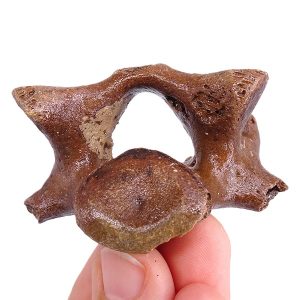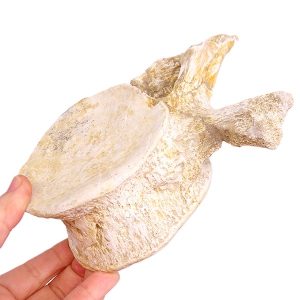

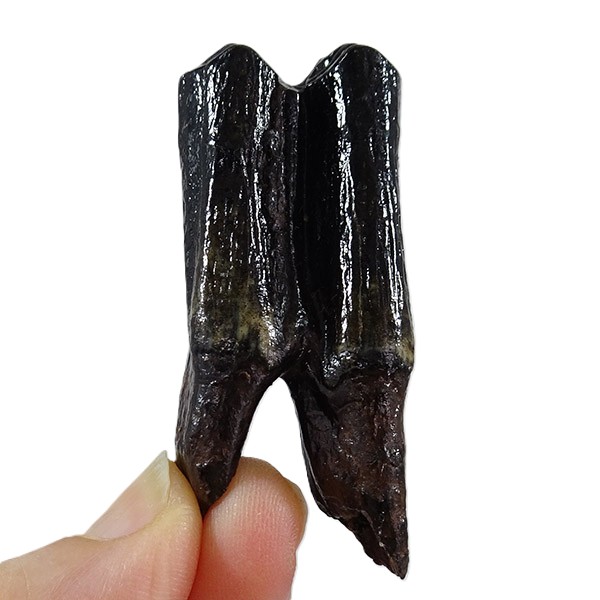
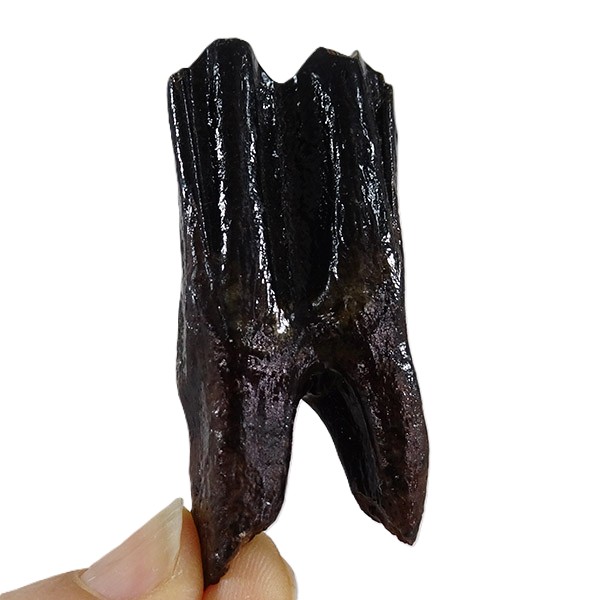
Bison priscus
48,00 €
Series: Pleistocene.
Origin: San River, Poland.
Measurements: 5.7 cm x 2.5 cm
Molar of the lower jaw of steppe bison.
The steppe bison had a specialized dentition for intensive grazing, composed of a total of 12 premolars y 12 molars hypsodonts (high crown). This symmetrical and robust structure was a key evolutionary adaptation for surviving the harsh steppes of the Pleistocene.
- hypsodontics: long crowns that emerged from the gum continuously to compensate for wear due to grass.
- premolars (P2, P3, P4): narrow pieces that cut and accommodated the food before grinding.
- molars (M1, M2, M3): Large and robust structures responsible for heavy chewing.
- lower third molar (m3): most distinctive piece, with three lobes, a hypoconulid and more than 40 mm in length.
- tooth replacement: baby teeth that emerged at birth and were replaced by permanent ones between 2 and 3 years of age.
These were animals similar to the current European bison, but much more robust and larger, with longer horns and adapted to life in open spaces such as the steppes and the limits of the tundra. Its relationships with the current bison species are not entirely clear, although it tends to be assumed that the species gave rise to the current European bison at the beginning of the Holocene from smaller forms such as Bison priscus mediator, which adapted to the new warm and forested environment that was beginning to replace the glacial tundra-steppe in Europe. The giant subspecies of Asia and North America, such as Bison priscus gigas, disappeared without offspring or gave rise to the current American bison (Bison bison).
Primitive man was a habitual hunter of this species. Steppe bison are frequently represented in cave paintings in France (Lascaux) and Spain (Altamira).