
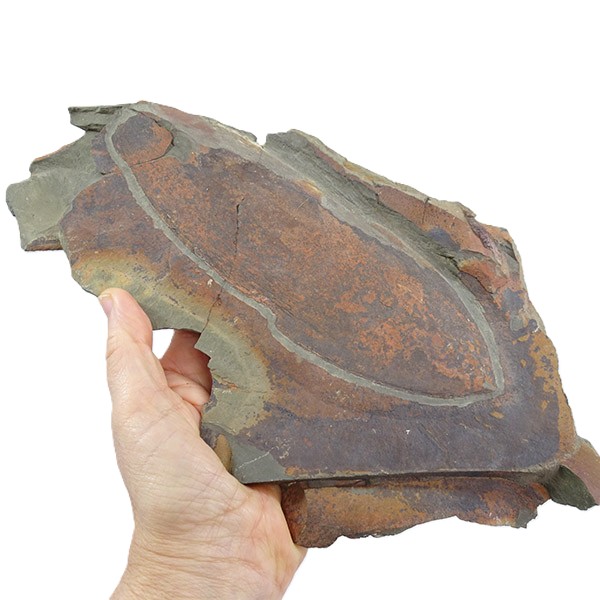
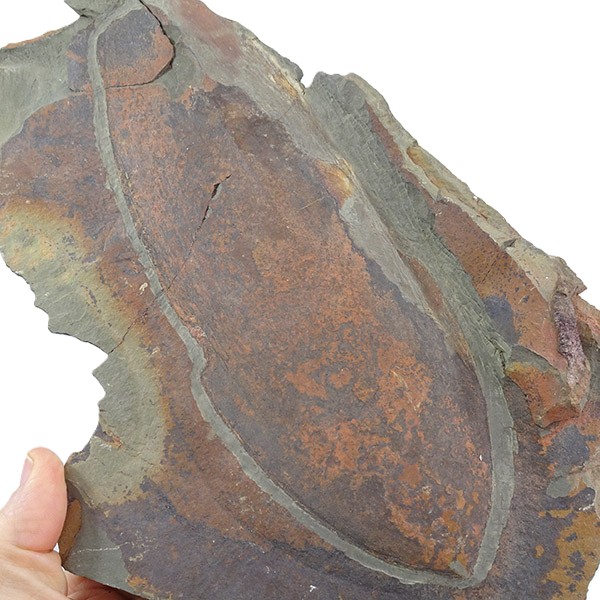
Aegirocassis benmoulae SOLD
System: Ordovician.
Formation: Fezouata.
Origin: Bou Chrebeb, Zagora, Morocco.
Plate measurements: 28.5 cm x 17 cm
Aegirocassis It is an extinct arthropod belonging to the family Hurdiidae who lived 480 million years ago during the beginning of the Ordovician.
It was the oldest known fossil of a larger animal that has a filter feeding.
When it was alive, it was the second largest animal on the planet, measuring more than two meters long.
Aegirocassis It had three large cephalic sclerites. The drop-shaped dorsal sclerite (carapace) is so long that it takes up half the length of the body, both edges of the shell had downward-facing triangular projections, which may have been the connection to the tips of the left and right shells below.
The front appendages are approximately 12 cm long and each is divided into seven segments. On the ventral surface of the first segment there is an endite smaller than the rest, with the second to fifth segments having five elongated endites. On each endite there are about 80 long bristle-like branches (auxiliary spines), which divide at the base into rounded joints. Each branch has another two rows of V-shaped cilia on both edges. The first segment of the appendix has a similar structure, but is relatively short.