
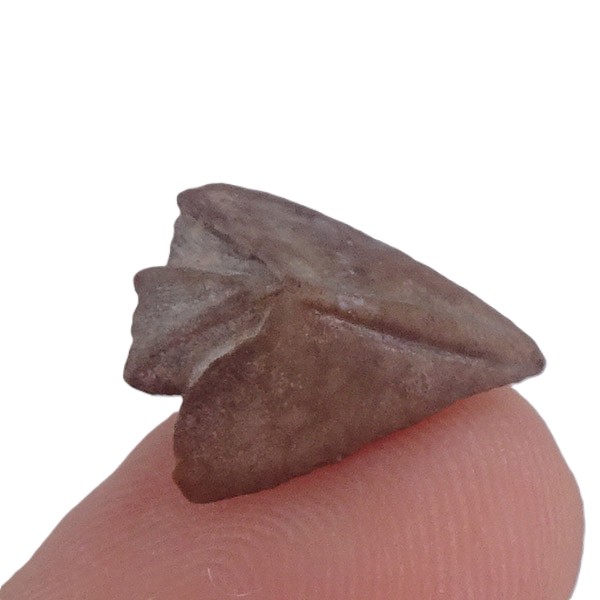
Akidocheilus sp. SOLD
System: Jurassic.
Stage: Bathonian.
Origin: Mecsek Mountains, north of Péc, Hungary.
Measurements: 1.4 cm x 1.2 cm
This piece is a rincolito, coming from the collection of Fritz J. Kruger (December 28, 1941 in Stettin; † January 30, 2025 in Braunschweig).
Rincolito (from the Gr. rhy´gchos, snout, and -líthos, stone):
- In a broad sense, any fossilized mandibular part of a nautiloid.
2. In a strict sense, upper jaw of a fossilized nautiloid.
Modern nautiluses are opportunistic predators and scavengers, eating their prey using a beak similar to that of a parrot capable of grasping and crushing hard foods such as crustaceans. This beak is made of chitinous upper and lower jaws. Through their feeding function, beaks contain crucial diet-related information.
Nautiluses, as the only modern representatives of phragmocone-bearing cephalopods, are key taxa to better understand the biology and evolution of recent and extinct cephalopods. Mostly known in the fossil record through their shells, the Nautilida probably diverged in the Devonian. After surviving major extinction events, the Nautilida have persisted to the present day. Nautilus y Allonautilus They are currently the only survivors of the once extremely diverse group of externally shelled cephalopods. This long and rich evolutionary history makes them key taxa to better understand the evolution, biology and ecology of extinct nautilids, as well as cephalopods in general.