
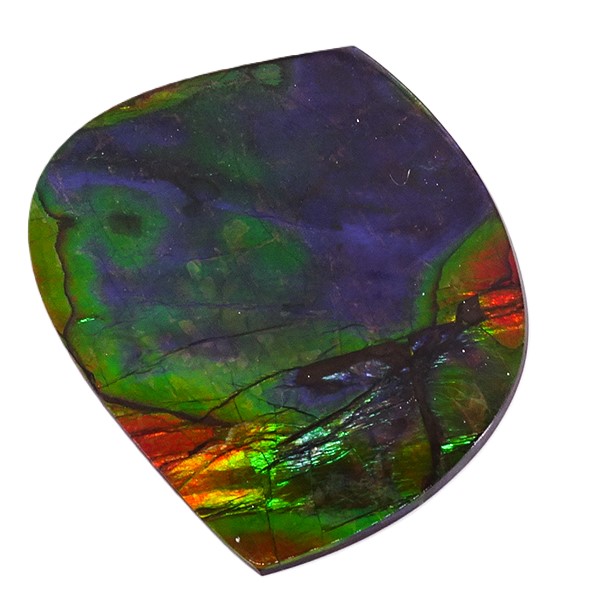
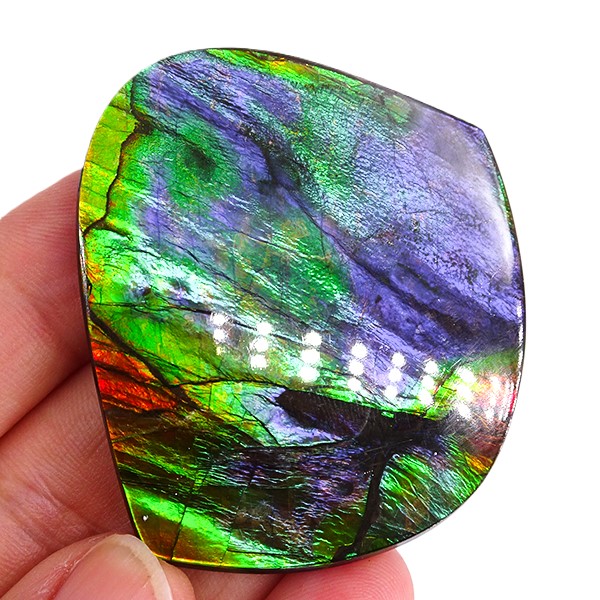
Ammolite
680,00 €
System: Cretaceous.
Formation: Bearpaw.
Origin: Lethbridge, Alberta, Canada.
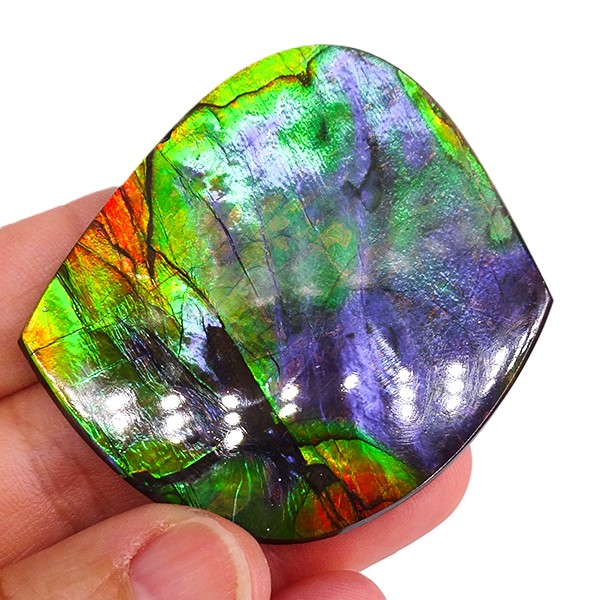
Measurements: 5.8cm x 5.4cm
The box is included in the price.
Ammolite is a rare and valuable organic gem found primarily on the eastern slopes of the Rockies of the USA y Canada. It is made up of the fossilized shells of ammonites, made up mainly of aragonite, the same mineral from which the pearls pearly.
The chemical composition of ammolite is variable, and in addition to aragonite it may include calcite, silica, pyrite and other minerals. The shell itself may contain some trace elements, including aluminum, barium, chromium, copper, iron, magnesium...
The best samples present an iridescent play of color opaline, with green and red tones; In any case, all colors of the visible spectrum can occur. The iridescence It is due to the microstructure of aragonite: unlike many other gems, whose colors come from the refraction of light, in ammolite its colors come from the interference of light bouncing off one of its many stacked layers of material that make up aragonite. At greater thickness, the colors are more reddish and greenish, and at lower thicknesses, blues and violets predominate. Reds and greens are the colors that occur most frequently, because thin thicknesses are more fragile and therefore less frequent. Freshly mined, the colors are not particularly striking; These appear after a polishing process and other treatments, which show the ammolite in all its splendor.
The ammolite itself is a thin layer, about 0.5-0.8 mm thick.
Ammolite comes from the fossil shells of ammonites in the shape of a disc Upper Cretaceous, typically the species Placenticeras meeki and Placenticeras intercalare, and to a lesser extent the baculites Baculites compressus.
The ammonites that gave rise to ammolite inhabited the subtropical internal seas that bordered the Rockies, when said sea disappeared, the ammonites were buried and compressed under layers of benthic sediment. This sediment preserved the aragonite of the shells, preventing its transformation into calcite. Through diagenesis, these shells were impregnated with trace elements present in the sediments, mainly iron and magnesium, which give the ammolite its predominance of green colors.