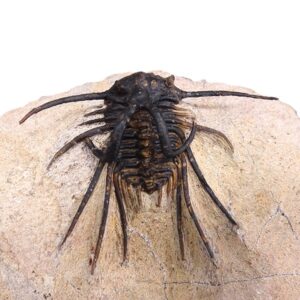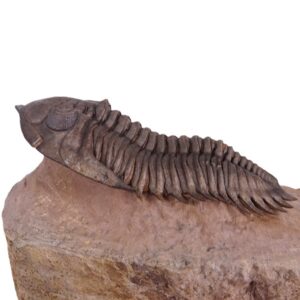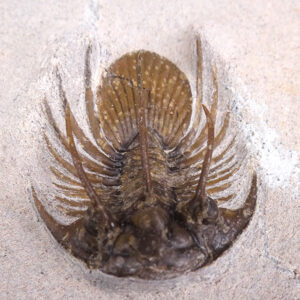



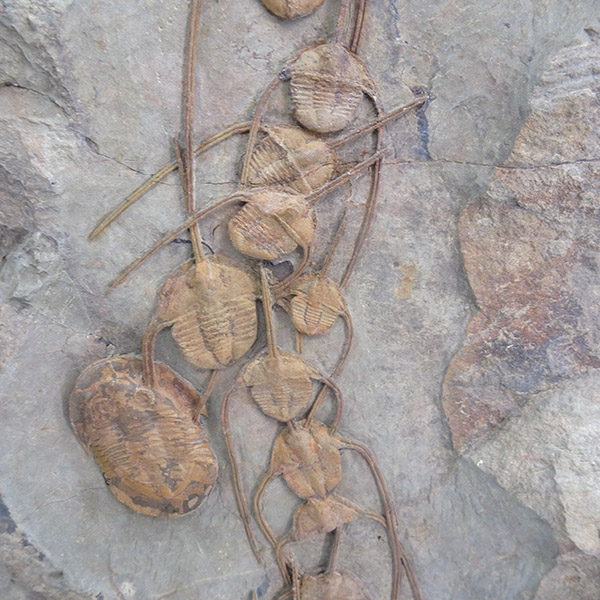
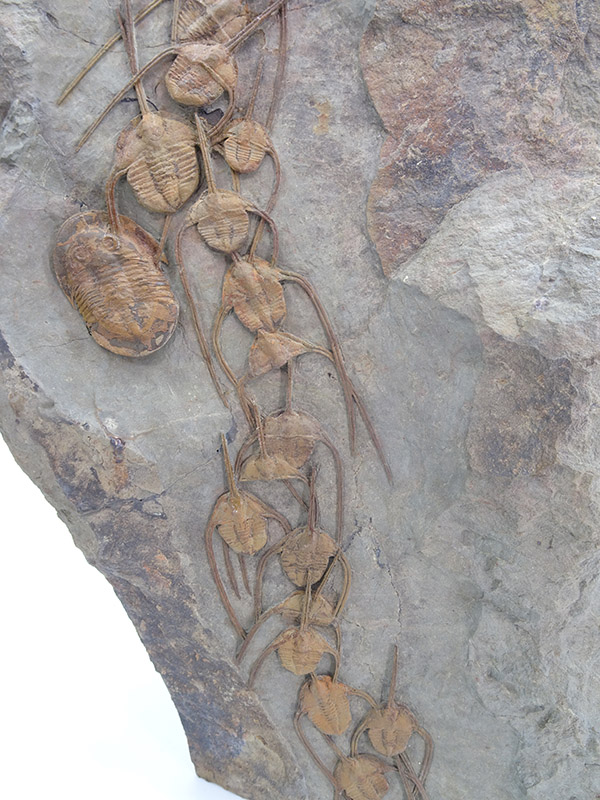
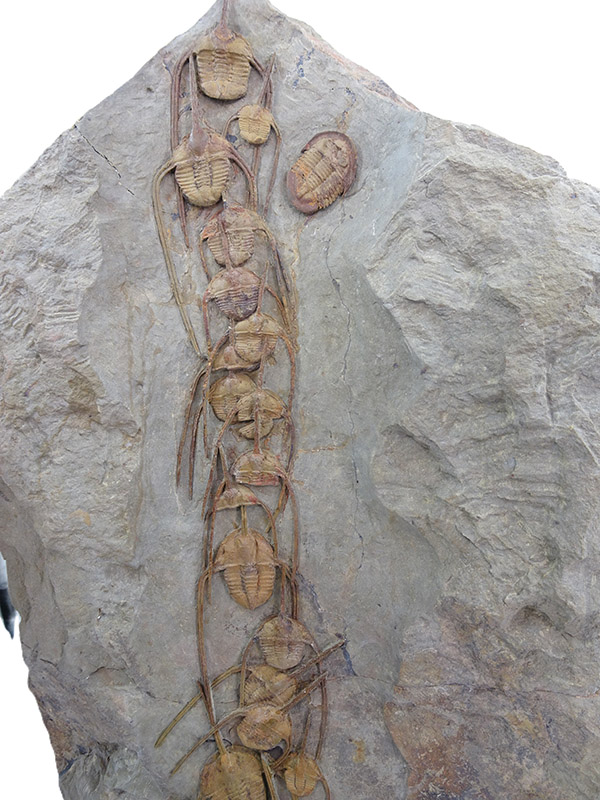
Amphyx priscus and Asaphellus aff. jujuanus SOLD
System: Ordovician.
Stage: Tremadocian – Floiense.
Formation: Fezouata.
Origin: Bni Zoli, Zagora province, region from Drâa-Tafilalet, Morocco.
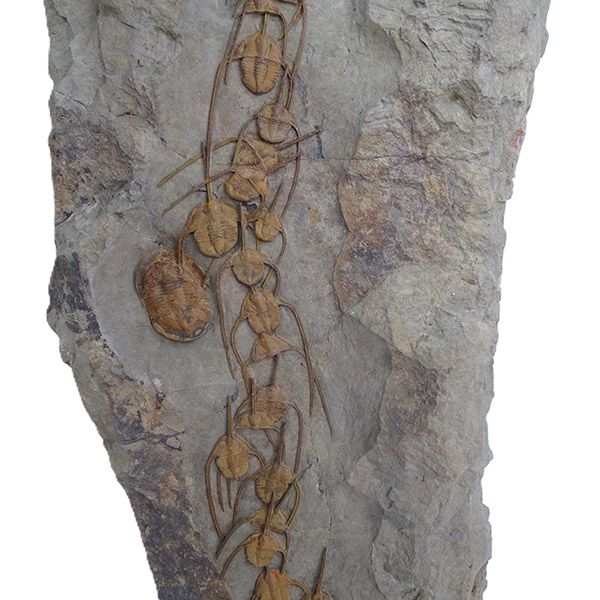
Plate measurements: 46 cm x 24 cm
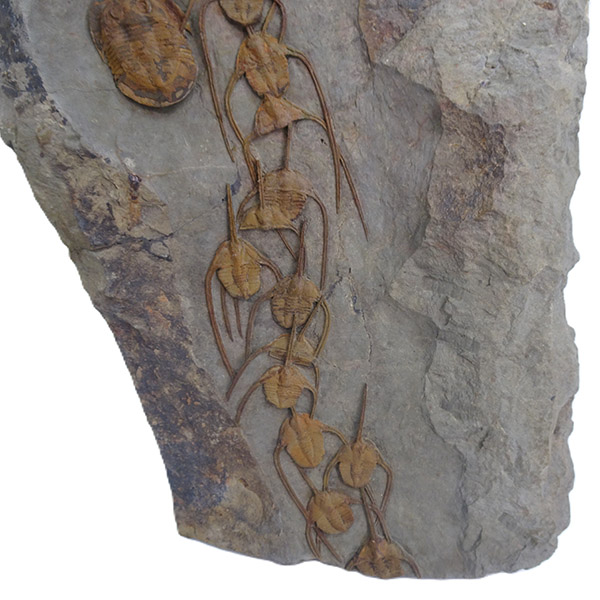
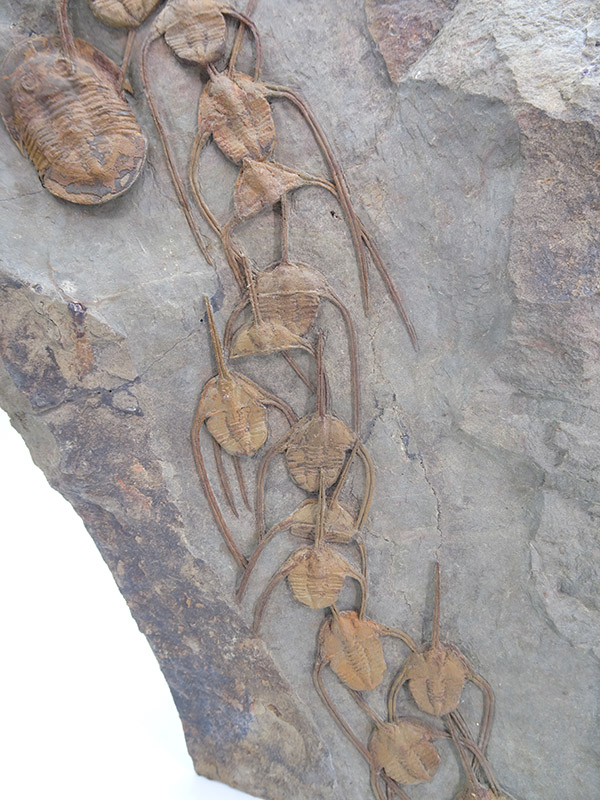
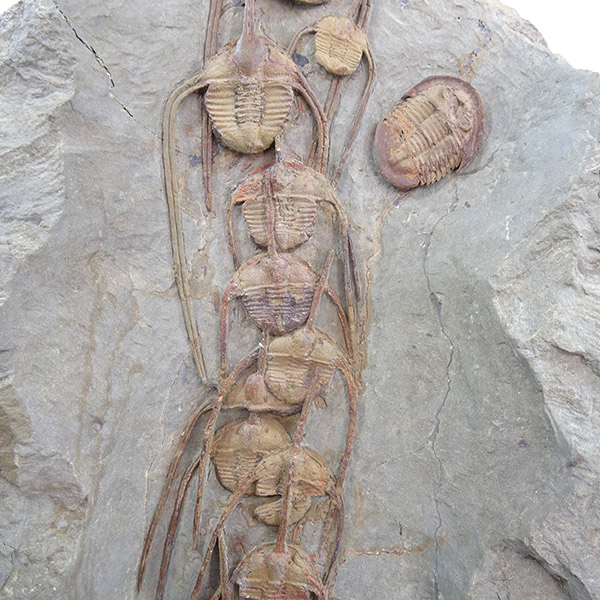
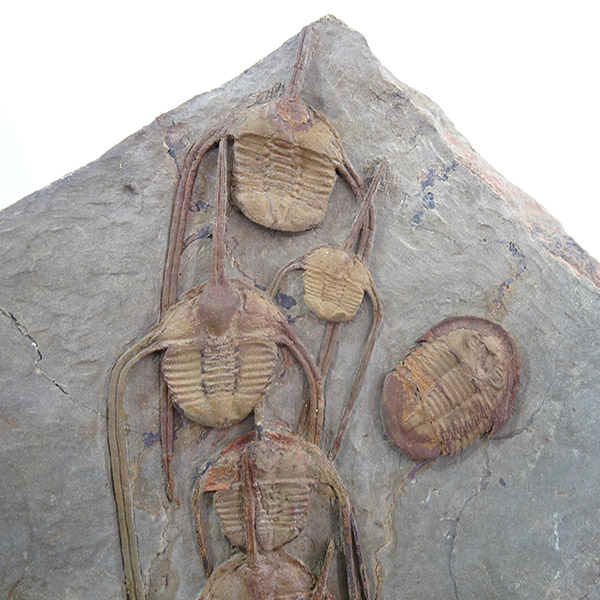
Ampyx priscus in linear formation in shale (very fine-grained sedimentary rock composed of clay and silt particles).
Fossils of Ampyx priscus, discovered in linear formation may indicate collective behavior in response to environmental cues or as part of seasonal reproductive migration.
The findings suggest that group behaviors comparable to those of modern animals existed as early as 480 million years ago.
Collective and social behavior is known to have evolved through natural selection for millions of years and modern arthropods provide numerous examples, such as the migratory chains of caterpillars, ants or locusts. However, the origins and early history of collective behavior have remained largely unknown.
Jean Vannier, a paleontologist at the University of Lyon, and his colleagues described several linear groups of Ampyx priscus. The trilobites, which were between 16 and 22 millimeters long, had a thick spine at the front of their bodies and a pair of very long spines at the back. In each group of trilobite fossils examined by the authors, individuals were arranged in a line, with the front of their bodies facing the same direction, maintaining contact through their spines. The authors suggest that this consistent linearity and directionality is unlikely to be the result of passive transport or accumulation by currents. Instead, it is more likely that Ampyx priscus died suddenly while traveling, for example, by being quickly buried by sediment during a storm.
The authors suggest that Ampyx priscus They probably migrated in groups and used their long projecting spines to maintain a single formation by physical contact as they moved along the seafloor. This may have been a stress response to the disturbance of their environment by storms, detected by motion and touch sensors, which motivated Ampyx priscus to migrate to calmer and deeper waters.
Comparable behavior is observed in extant spiny lobsters. Alternatively, the pattern may have been the result of seasonal reproductive behavior involving the migration of sexually mature individuals to spawning grounds. Knowing that Ampyx priscus was blind, the authors hypothesize that trilobites may have coordinated by using sensory stimulation through spines and chemicals.
The discovery shows that a 480-million-year-old arthropod may have used its neural complexity to develop temporary collective behavior.