
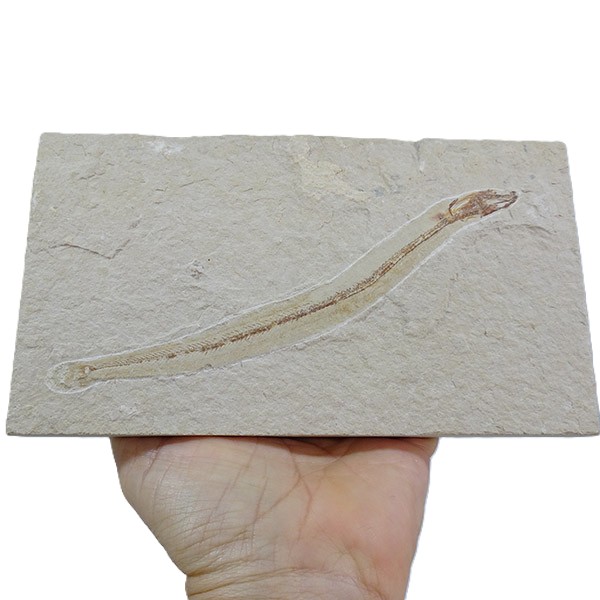
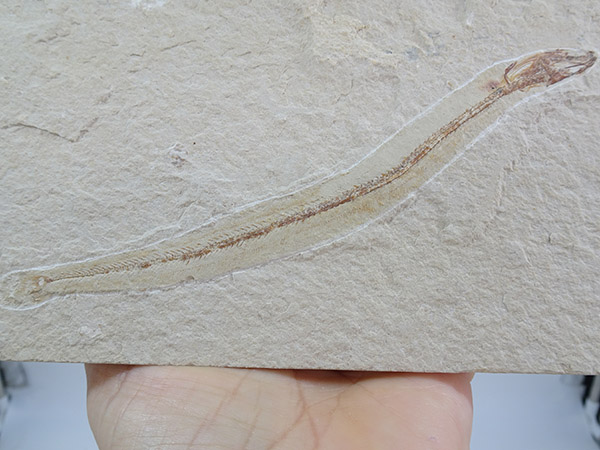
Anguillavus quadripinnis
250,00 €
System: Cretaceous.
Series: Superior.
Stage: Cenomanian.
Origin: Hgula, Lebanon.
Measurements: 18.2 cm x 10 cm
1 in stock
Anguillavus is an extinct genus of prehistoric actinopterygian (ray-finned) fish. It was described by Hay in 1903. It lived in Lebanon and was originally described as a primitive eel with pelvic fins, unlike modern eels.
Anguiliforms have an elongated body that resembles that of a snake, with both marine and river species. Eels are very elongated fish and usually have bare skin without scales, and when they do have them, they are cycloid type embedded in the skin; The opening of the gills is usually very narrow and displaced backwards in the body, they have jaws with well-formed teeth throughout the mouth, they all have a swim bladder. Eels swim generating waves that travel throughout their bodies.
They appear for the first time in the fossil record during the Cretaceous period.
Most eels live in the shallow waters of the ocean and bury themselves in sand, mud, or among rocks. Most eel species are nocturnal, so they are rarely seen. They are sometimes seen living together in holes or "eel pits." Some eel species also live in deeper waters on continental shelves and on slopes as deep as 4000 m. Only members of Anguilla They regularly inhabit fresh water, but also return to the sea to reproduce.
In 1981, the holotype was re-examined Anguillavus hackberryensis from Cenomanian marine strata in Kansas, after which the genus was redescribed as a genus of fish in the order Aulopiformes (they are pelagic or benthic species sometimes called lizardfish, sabertooth fish, and lancetfish...)