
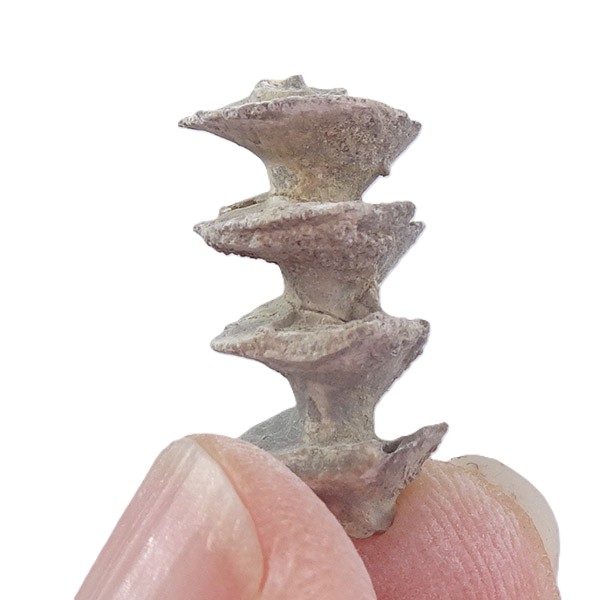
Archimedes worthemi
9,00 €
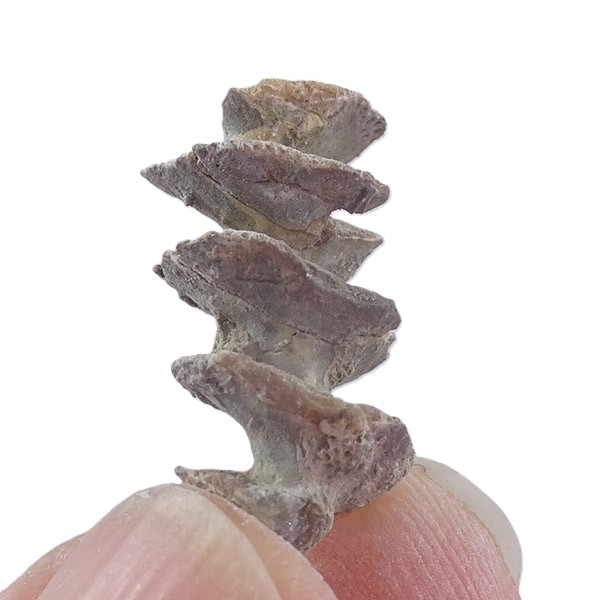
System: Carboniferous.
Subsystem: Mississippian.
Formation: Ramp Creek.
Origin: Montgomery, Indiana, USA.
Measurements: 2.1 cm x 0.6 cm
Archimedes is considered a guide fossil important for the Mississippian period because it is a fossil remains used to date rocks, since they lived in a very short geological time interval, had a large geographical distribution, were abundant and easy to identify, allowing a precise age to be assigned to the strata that contain them in different parts of the world.
The specific name "wortheni" was named in honor of Amos Worthen, an Illinois state geologist.
The bryozoans (Bryozoa, Greek "moss animals") or ectoprocts (Ectoprocta, Greek "external anus") are invertebrate animals colonial aquatic, mostly marine but there are also freshwater bryozoans. They have a lophophore, a crown of ciliated tentacles that serve to capture food, in which the anus opens outside of said tentacle crown. Colonies are made up of individuals called zooids, that are formed by budding, a type of asexual reproduction, where a primary zooid or ancestral, born from sexual reproduction, produces new individuals (zooids) identical to it through shoots (buds) that grow and integrate into the colony, allowing its expansion and the regeneration of individuals, thus creating a clonal network of identical beings. In principle, most zooids are self-sufficient in feeding and reproducing asexually. But a characteristic of some groups is the polymorphism of their zooids, which allows different zooids in the colony to assume different functions such as feeding, defense and sexual reproduction (devoting themselves to producing gametes (eggs and sperm) to form new colonies). In most bryozoans, each zooid is protected by a carbonate exoskeleton perforated by pores and crossed by an interconnecting network (the funiculus), so that all zooids in the colony are linked to each other.
Within the skeleton, each zooid has a fleshy part made up of a curved tube, so that both ends, the mouth and the anus, are close together. The mouth is surrounded by a crown of ciliated tentacles called a lophophore. The movement of these cilia creates water currents that direct food particles toward the animal's mouth. Bryozoans are filter-feeding suspension feeders, feeding almost exclusively on plankton.
Bryozoans are organisms benthic which mostly live fixed in a substrate (sessile), but some species have a free way of life and can even move discreetly. Colonies generally settle on rock surfaces, shells, vegetables and other substrates. Zooids are very small, approximately 0.5 mm on average, but the colonies they make up are very variable in size and, although they generally measure only a few centimeters in diameter, some species can build structures a few decimeters or a few meters in length.