
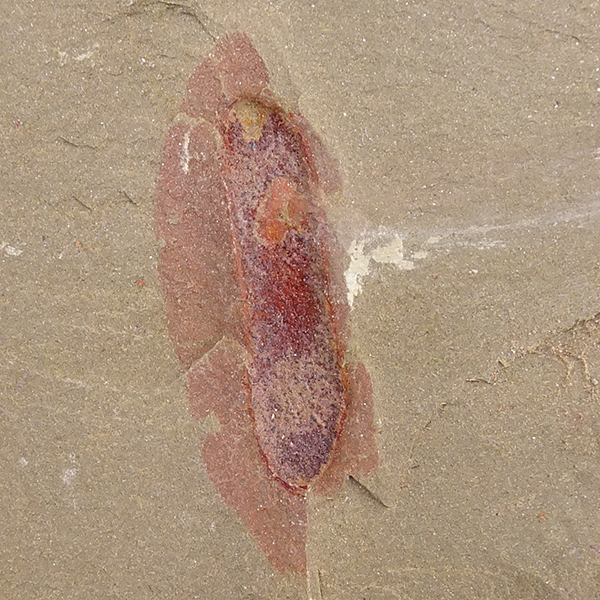
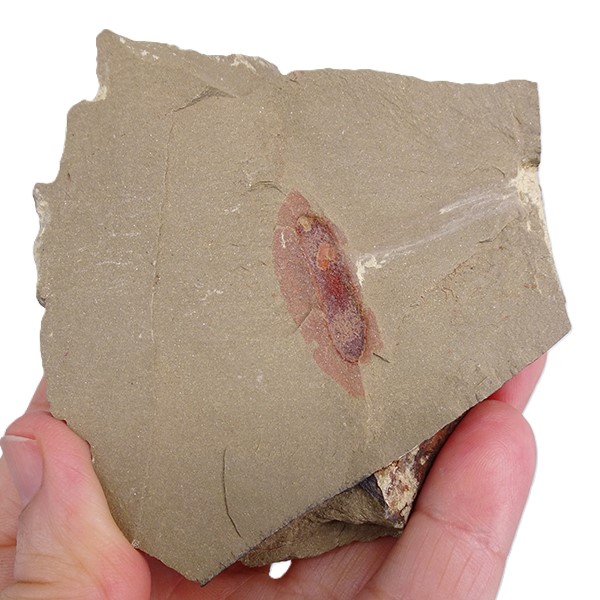
Calvapilosa kroegeri SOLD
System: Ordovician.
Stage: Tremadocian
Formation: Fezouata.
Origin: near Zagora, Morocco.
Plate measurements: 9 cm x 8 cm
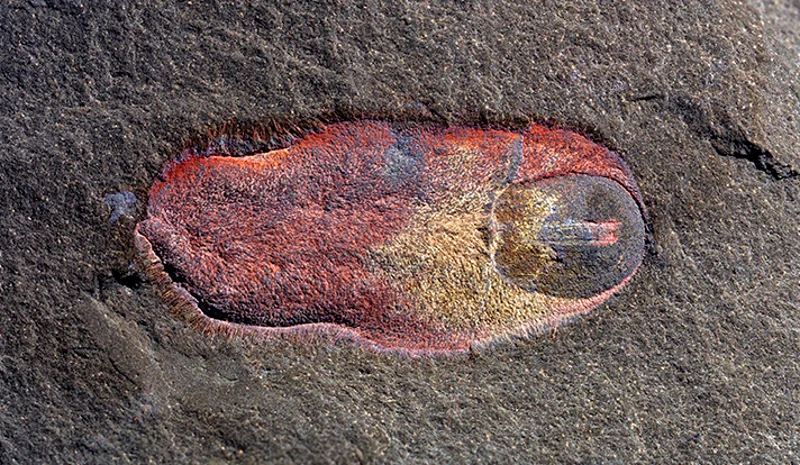
Calvapilosa is a fossil similar to a 480 million year old slug that sheds light on the evolution of mollusks.
One of the defining characteristics of mollusks is the possession of a radula, which is an oral structure formed by a ribbon that moves back and forth. On this tape we find several rows of small teeth that are used to scrape food. Although not all mollusks have a radula, a radula cannot be found in any other group of animals.
Mollusks are among the first identifiable animals in the fossil record, however determining their ancestor was difficult. The recent discovery of a new species of mollusk in the Anti-Atlas region of Morocco has allowed paleontologists to revisit this problem and deduce the emergence of the ancestor of all mollusks.
Calvapilosa kroegeri is thought to resemble a slug covered in short spines all over its upper body and with a large 'claw shell' on its head. The head of this species has a radula, this means that Calvapilosa kroegeri is a mollusk.
Following an analysis to determine the mollusk family tree, Calvapilosa kroegeri was revealed to be the most primitive member of the lineage leading to chitons. This genus can still be found today and is characterized by the possession of a shell made up of eight plates and spines around its edge, similar to what is seen covering the body of Calvapilosa. If we trace the evolution of chitons, we can see that the number of their plates has increased over time, so it is likely that the ancestor of all mollusks was single-shelled and covered in spines, not unlike Calvapilosa kroegeri.
The Fezouata deposits, near the Moroccan city of Zagora, are providing a rich sample of a fauna similar, although later in time, to the famous Burgess Shale (Canada). We are talking about fossils between 480 and 472 million years old. The age indicates that the Burgess Shale type communities were not restricted, as was believed, to the early stages of the Cambrian and then suddenly disappeared, but rather they survived much longer, coexisted with the later fauna and would be the normal type of deep sea fauna throughout the planet. So Morocco was an ocean and was over the South Pole.