
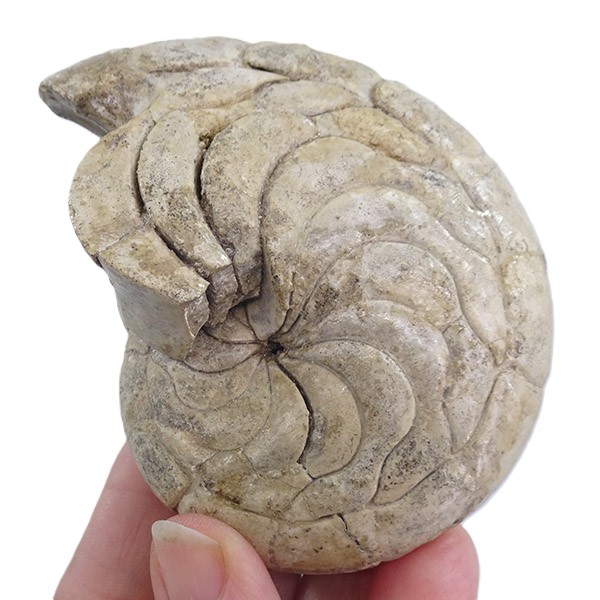
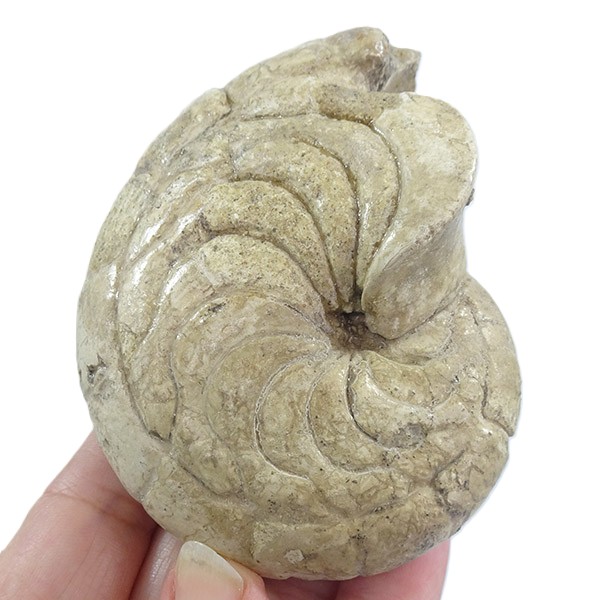
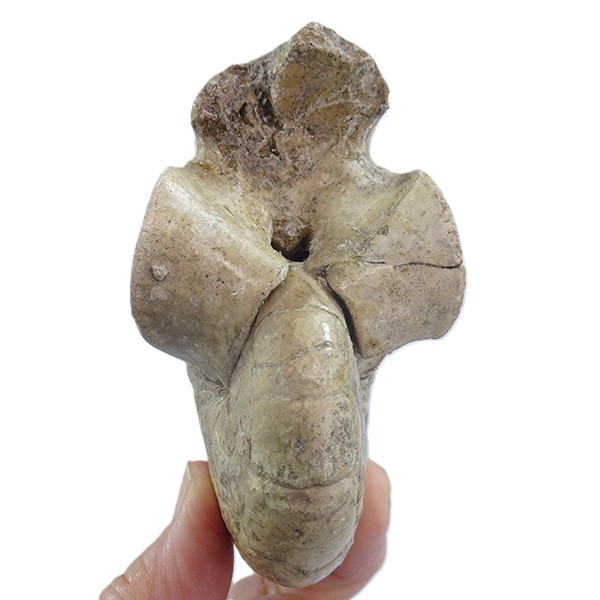
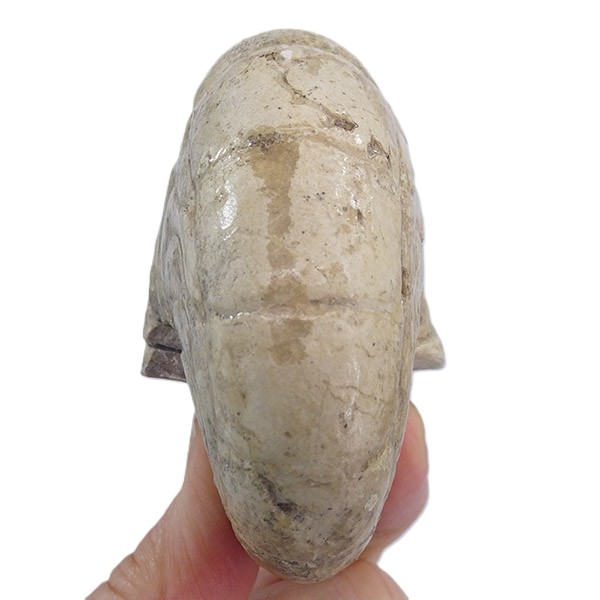
Hercoglossa cf. jacobi
155,00 €
Series: Eocene.
Stage: Lutetian.
Origin: Cape Bojador, Western Sahara.
Measurements: 9.5 cm x 7.1 cm
Hercoglossa it's a nautiloid.
Nautiloids or nautiloids (Nautiloida) are a subclass of cephalopod mollusks that appeared at the beginning of the Paleozoic, being the main marine predators. More than 2,500 species are known, although few have survived to the present day.
Nautiloids have two pairs of gills, which is why they are also known as tetrabranchs and have an external shell, which can be straight, arched or rolled. This shell is divided internally into a series of chambers filled with gas and separated by partitions that have the concavity directed towards the opening (procelic partitions), unlike those of other cephalopods such as ammonoids in which the concavity is directed towards the interior (opisthocoelic partitions). The first and largest chamber is called the habitation chamber. It is the outermost chamber and in which the individual lives. The rest of the chambers are smaller and may be filled with gas or liquid, being used to regulate flotation. The partitions that separate the chambers are pierced by a tube that connects all the chambers: the siphuncle. The insertion of these septa into the shell causes lines, called suture lines, which in nautiloids are straight or slightly sinuous (except in Aturia which has lines similar to goniatitidae).
The soft parts can be grouped into two different units:
- he body, which is completely covered by the mantle and which in turn contains the viscera and the pallial cavity.
- the head tentaculate, a cartilaginous structure in which the mouth is formed by a horny beak and a variable number of tentacles, more than 90 being identified in current nautiloids. The eyes occupy a lateral and symmetrical position on the head. On the dorsal part it has a hard tissue, the hood, which serves as protection against predators. Below the tentacles is the hyponome or siphon, which consists of a long, tubular structure that can be oriented in any direction.