
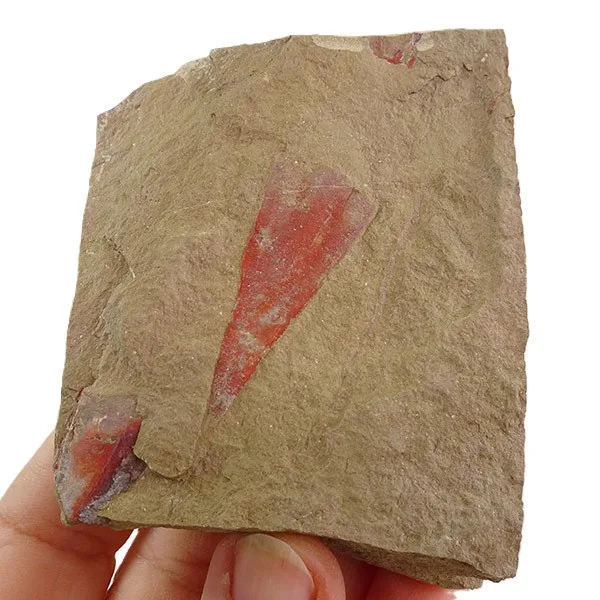
Pauxillites sp.
45,00 €
System: Ordovician.
Stage: Floiense.
Formation: Fezouata.
Origin: Zagora, Morocco.
Plate measurements: 7.9 cm x 6 cm
1 in stock
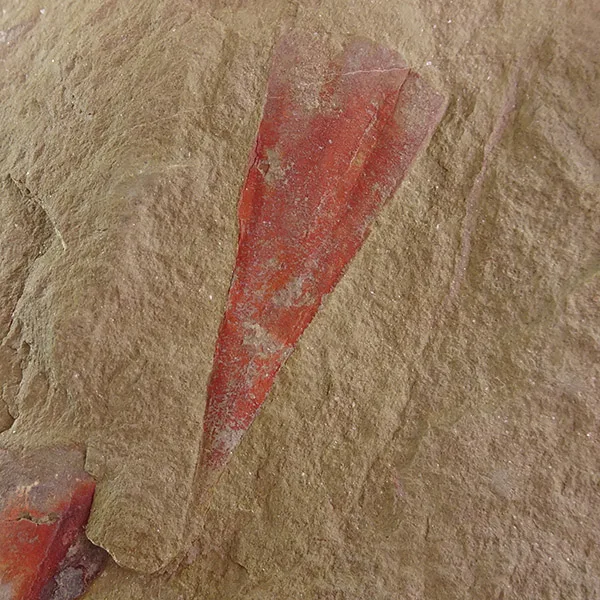
Dorsal side of Pauxillites.
Pauxillites It was a hyolith. The hyoliths They are a kind of small animals lophophoratedconical-shaped shell that lived in the Paleozoic era. Its fossils are found from the beginning of the Cambrian to the end of the Permian, although they are not very abundant from the Ordovician onwards. For a long time they were considered mollusks or similar to them.
The calcareous shells are conical, triangular or semicircular in section and usually flattened in the ventral area. They had a cover or operculum, usually articulated. Hyolithids also had two curved rods, known as hellenes, which are interpreted as support structures to raise the shell above the substrate. The shells could be ornamented with longitudinal folds or present growth lines.
It has been observed that they had an extendable lophophore with tentacles, used as a feeding organ, and a long U-shaped stomach.
The taxonomic position of hyoliths has always been uncertain, until in 2017 their inclusion in Lophophorata was determined, a group that includes brachiopods, phoronids and bryozoans thanks to the study of specimens that preserve impressions of soft tissues and the lophophore was studied. The lophophore (from lophos, crest and phoreus, bearer) is a crown or horseshoe-shaped structure provided with numerous cilia that surround the mouth. The vibration of the cilia causes a current of water that attracts particles suspended in the water towards the tentacles, where they are retained and taken to the mouth. This type of feeding is known as suspension feeding.
We include Pauxilites in the phylum brachiopods, because it is related to them.
The Fezouata deposits, near the Moroccan city of Zagora, are providing a rich sample of a fauna similar, although later in time, to the famous Burgess Shale (Canada). We are talking about fossils between 480 and 472 million years old. The age indicates that the Burgess Shale type communities were not restricted, as was believed, to the early stages of the Cambrian and then suddenly disappeared, but rather they survived much longer, coexisted with the later fauna and would be the normal type of deep sea fauna throughout the planet. So Morocco was an ocean and was over the South Pole.