
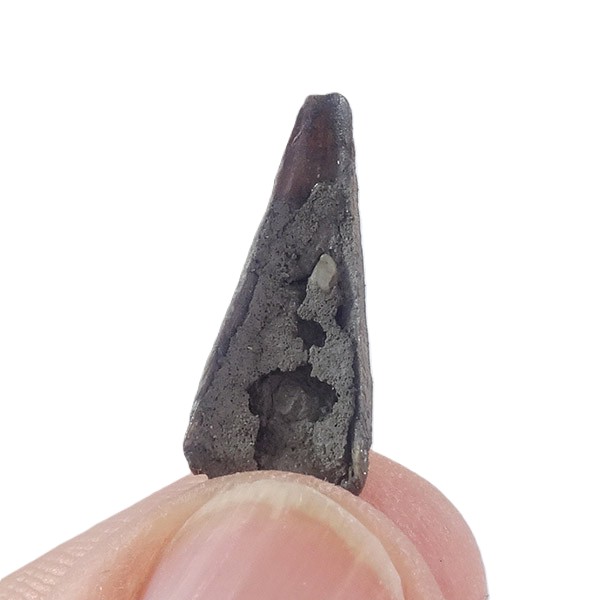
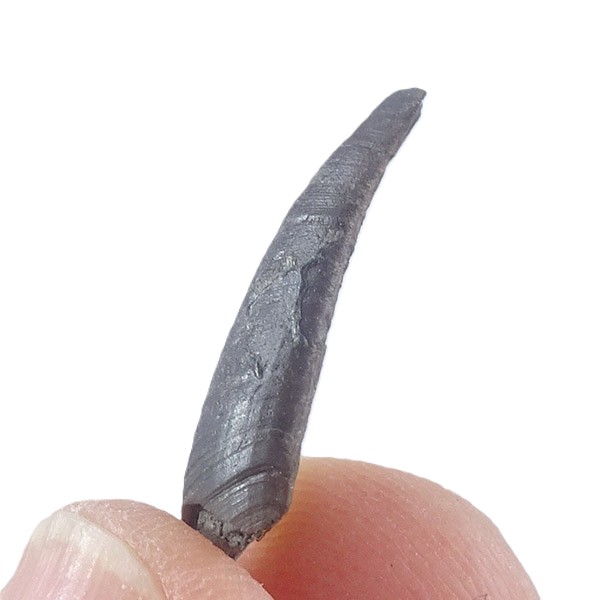
Stramentidae SOLD
System: Cretaceous.
Stage: Albianse.
Origin: Clérey, Champagne-Ardenne region, Aube department, France.
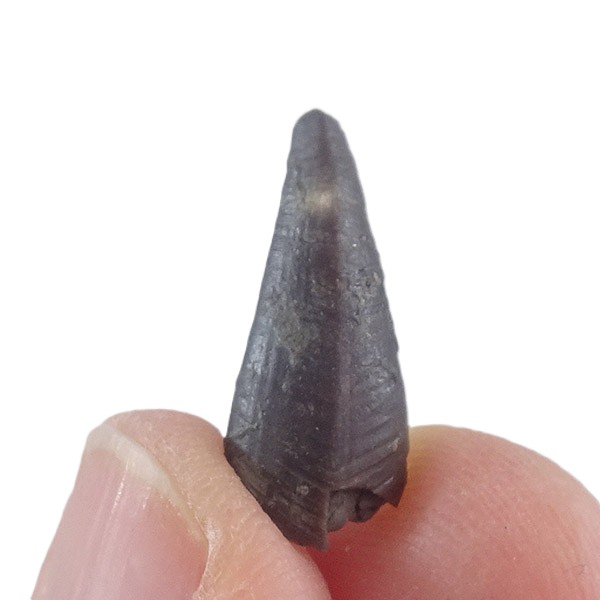
Measurements: 2 cm x 0.8 cm
Calcareous plate of a barnacle belonging to the family Stramentidae (calcareous outer layer is made up of 9-12 plates and a large fleshy pedicle for attachment to the substrate).
The barnacles are marine crustaceans stationary with a hard exoskeleton that covers most, if not all, of the animal. They attach to hard substrates, sometimes to other living animals such as whales, and are filter feeders using long feathery appendages called cirri.
The adult barnacle has two clearly differentiated parts, the upper part or chapter, and the lower part or peduncle, which would be the part that is attached to the rock.
The upper part, the capitula, is commonly known as the barnacle nail, due to the appearance given to it by a series of grayish-white calcareous plates. This nail protects the animal:
- from the attack of a possible predator.
- of desiccation at times of low tide where the water level drops and the animal is exposed to the air.
That this part is especially protected is no coincidence: under these plates most of the barnacle's vital organs appear, in what is known as the barnacle prosoma.
As for the peduncle, it has a cylindrical shape and is covered by a strong skin. Its flexibility allows it to contract, stretch and move in any direction thanks to the action of three muscle bundles. These movements, on the one hand, facilitate the feeding of the barnacle, since they allow it to orient itself in the direction of the current, and, on the other hand, they are of great importance when it comes to reproduction, facilitating the approach of the reproductive systems of the two adults involved in copulation.