
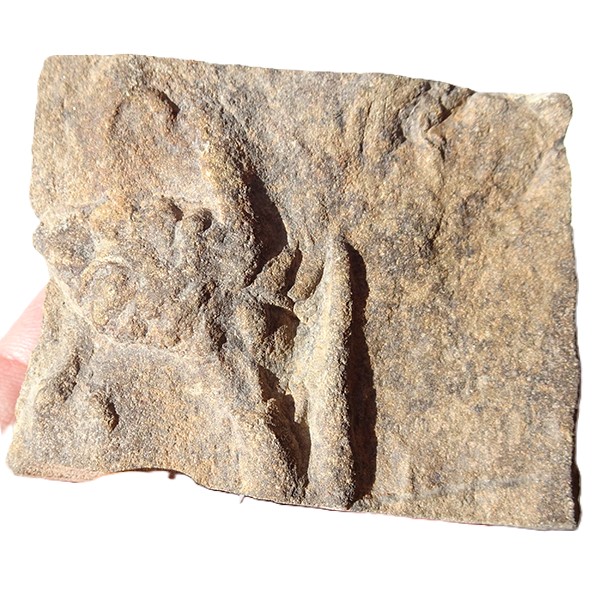
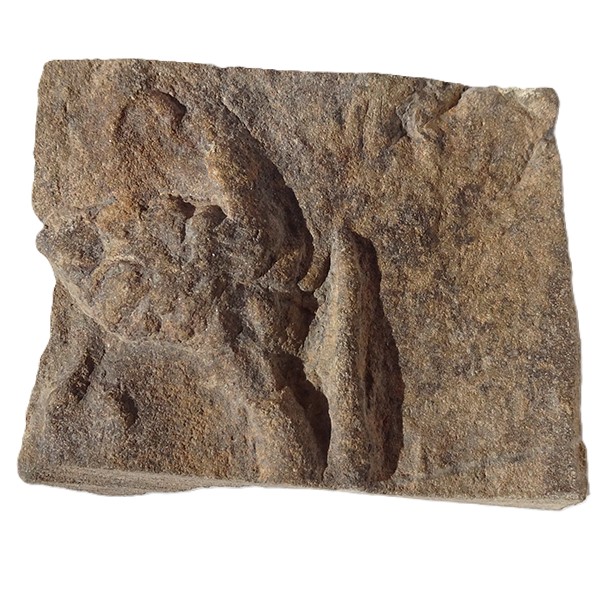
Nereites cf. irregularis VENDIDO
System: Ordovician.
Stage: Katense.
Formation: Thiouririne Superior.
Origin: near Taouz, Morocco.
Plate measurements: 6.2 cm x 5 cm
Nereites is a genus of ichnofossils that takes its name from the annelids of the gender Nereis, the organisms with which these traces were first described.
The traces consist of narrow tubes of meandriform development with circular to oval lobes on both sides. The central tube is usually filled with sediment and sometimes has fecal pellets inside.
The Upper Tiouririne Formation has been studied sedimentologically and its most striking characteristics are the record of slightly mineralized and soft-bodied fossils, which are exceptionally preserved in several of the massive sandstone beds (Tafilalt Biota). This “Ediacara-type” preservation is linked to episodes of very quick burial, possibly influenced by storms, of organisms with biopolymeric tissues preserved on special microbially bound substrates.
The trace-fossil association is diverse. The following ichnotaxa could be identified: Arenicolites isp., Asteriacites cf. lumbricalis, Cruziana problematica, Cruziana isp., Curvolithus simplex, Diplocraterion parallel, Gyrchorte comosa, Heughia gregaria, Nereites cf. irregularis, Nereites macleayii, N. pugnus, Oravaichnium hrabei, Protovirgularia dichotoma, P. rugosa, Taenidium barretti, T. serpentinum, Teichichnus rectus, Rusophycus carleyi, Rusophycus isp...
This association of trace fossils is characteristic of a Shallow marine environment, probably coastal, and relatively high ichnodiversity is indicative of favorable living conditions for benthic organisms.
https://www.researchgate.net/publication/334974500_ORDOVICIAN_TRACE_FOSSILS_FROM_THE_UPPER_TIOURIRINE_FORMATION_OF_MOROCCO_PRELIMINARY_RESULTS